Melatonin is the most heavily studied compound in this catalogue by a wide margin, and that creates a different problem from the one peptides usually present. With most research compounds the difficulty is a thin literature. With melatonin it is the opposite: tens of thousands of papers, a large fraction of them preclinical, and a public conversation that has run well ahead of what the controlled trials actually found. This page sets out what has been published, with every citation linked to PubMed. We supply Melatonin for laboratory research only, so nothing below is a claim about effects in humans.
What melatonin is
Melatonin is an indoleamine hormone, not a peptide. It is synthesised from tryptophan by way of serotonin, principally in the pineal gland, and its release is governed by the suprachiasmatic nucleus and suppressed by light. That last point is not a footnote. A 2011 study in the Journal of Clinical Endocrinology and Metabolism showed that ordinary room light before bedtime suppresses the onset of endogenous melatonin and shortens the duration of its nightly secretion, which means the baseline any experiment is measured against moves with the lighting conditions of the room.
Its receptors are better characterised than those of most compounds discussed on this site. MT1 and MT2 are G-protein-coupled receptors with distinct distributions and distinct downstream effects, reviewed in 2016 in Annual Review of Pharmacology and Toxicology. The existence of licensed receptor agonists – ramelteon, tasimelteon, agomelatine – is a useful sanity check on the pharmacology, and a 2025 review in Molecules compares them directly with melatonin itself.
Sleep: the best-evidenced area, and the most misread
This is where the controlled trials are, and the picture is consistent rather than dramatic.
A 2013 meta-analysis in PLoS One pooled randomised trials in primary sleep disorders and found statistically reliable effects on sleep onset latency, total sleep time and sleep quality. The effects were real and they were small. A 2022 systematic review and meta-analysis in the Journal of Neurology reached a similar conclusion on sleep quality across a broader population, and a 2022 review in Sleep Medicine Reviews examined the specific case of chronic insomnia, where melatonin performs less impressively than its reputation suggests.
The most useful single paper for anyone designing an experiment is a 2024 systematic review and dose-response meta-analysis in the Journal of Pineal Research, which looked at timing and dose together rather than dose alone. Its findings run against the intuition that more is better: the relationship is not linear, and when the compound is given matters at least as much as how much.
Two population-specific reviews are worth knowing about because they are frequently cited out of context. A 2023 meta-analysis in Progress in Neuro-Psychopharmacology and Biological Psychiatry covered sleep disorders in autistic people, where effects are larger than in the general population, and a 2025 meta-analysis in Critical Care Medicine examined use in intensive care. Neither generalises to healthy adults, though both are routinely quoted as though they do.
Circadian phase shifting
Conceptually this is separate from the sedative-like effect on sleep onset, and confusing the two is the most common error in the popular literature. Melatonin given at the right point in the circadian cycle shifts the clock; given at the wrong point it shifts it the other way.
The classic evidence is a 2002 Cochrane review on melatonin for the prevention and treatment of jet lag, which remains the reference point despite its age, with a 2015 re-appraisal in Medwave revisiting the question. For a laboratory measuring phase rather than self-reported sleep, dim light melatonin onset is the standard marker: a 2023 paper in Sleep characterises how it varies across ages, methodologies and sex, a 2022 paper in Chronobiology International compares plasma and saliva sampling, and a 2024 protocol in the Journal of Pineal Research describes at-home salivary assessment.
Pharmacokinetics, and why they complicate everything above
Melatonin undergoes extensive first-pass hepatic metabolism, described in a 1985 paper in the Journal of Clinical Endocrinology and Metabolism. A 2000 study in the Journal of Clinical Pharmacology measured absolute oral bioavailability directly and found it both low and highly variable between individuals.
That variability is the reason dose-finding in this literature is so untidy. Two participants given the same oral dose can reach very different plasma concentrations, so trials that report only the administered dose are reporting something less informative than it looks. A 2016 systematic review in Drug Research covers the pharmacokinetics of alternative administration routes, which is the obvious response to a first-pass problem and the reason non-oral routes appear so often in research protocols.
The antioxidant literature
This is the largest body of work on melatonin and the one that should be read most carefully, because almost none of it is clinical.
A 2016 review in the Journal of Pineal Research, titled without much modesty as melatonin “under promises but over delivers” as an antioxidant, sets out the mechanistic case: direct radical scavenging, effects on antioxidant enzyme expression, and a metabolite cascade in which the breakdown products are themselves active. Its concentration in mitochondria is a recurring theme, examined in tissue-specific reviews on hypertension and on skin, both published in Cellular and Molecular Life Sciences in 2017, and a 2024 review in the International Journal of Molecular Sciences covers melatonin and its metabolites in the context of brain ageing.
The honest summary is that the mechanistic work is substantial and the clinical translation is not. The concentrations used in much of the cell and animal work are far above anything endogenous secretion produces, which is precisely why this material sits under in-vitro research rather than anywhere else.
What we supply, and how it is tested
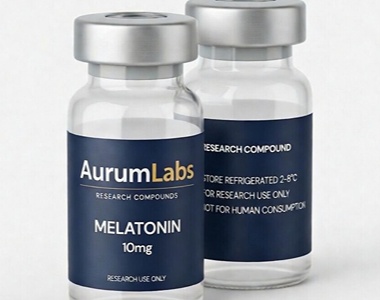
Our Melatonin is supplied at 10mg as a lyophilised powder for laboratory use. Every vial ships with a batch-specific Certificate of Analysis, and our guide to reading a certificate of analysis explains what identity and purity figures on that report actually establish, and what they do not.
Melatonin is worth a specific word on purity, because it is cheap and widely produced, and cheap widely produced material is where content variance tends to show up. A report that states the analytical method and the laboratory that ran it is doing more work than one that states a number alone.
Limits of the current evidence
Firstly, the sleep effects in healthy adults are consistent but modest. Meta-analyses find them reliably; they do not find them large.
Secondly, timing and dose are not interchangeable, and a study that varied one without controlling the other is hard to interpret.
Thirdly, the antioxidant and mitochondrial literature is overwhelmingly preclinical, frequently at concentrations with no physiological counterpart.
Finally, findings in specific clinical populations – autistic people, intensive care patients, shift workers – do not transfer to the general case, however often they are quoted as though they do.
Research use only
AurumLabs supplies Melatonin strictly for in-vitro laboratory research. It is not for human or animal consumption, and it is not a medicine or a supplement. Accordingly, everything on this page summarises published research and makes no claim about effects in people, nor any recommendation for use by any route. Each vial ships with a batch-specific Certificate of Analysis. More summaries are in our research library.
References
- Liu J et al. MT1 and MT2 melatonin receptors: a therapeutic perspective. Annu Rev Pharmacol Toxicol, 2016. PMID: 26514204
- Żełabowski K et al. The efficacy of melatonergic receptor agonists used in clinical practice in insomnia treatment. Molecules, 2025. PMID: 41011705
- Gooley JJ et al. Exposure to room light before bedtime suppresses melatonin onset and shortens melatonin duration in humans. J Clin Endocrinol Metab, 2011. PMID: 21193540
- Ferracioli-Oda E et al. Meta-analysis: melatonin for the treatment of primary sleep disorders. PLoS One, 2013. PMID: 23691095
- Fatemeh G et al. Effect of melatonin supplementation on sleep quality: a systematic review and meta-analysis of randomized controlled trials. J Neurol, 2022. PMID: 33417003
- Choi K et al. Efficacy of melatonin for chronic insomnia: systematic reviews and meta-analyses. Sleep Med Rev, 2022. PMID: 36179487
- Cruz-Sanabria F et al. Optimizing the time and dose of melatonin as a sleep-promoting drug: a systematic review of randomized controlled trials and dose-response meta-analysis. J Pineal Res, 2024. PMID: 38888087
- Nogueira HA et al. Melatonin for sleep disorders in people with autism: systematic review and meta-analysis. Prog Neuropsychopharmacol Biol Psychiatry, 2023. PMID: 36584862
- Tang BHY et al. Melatonin use in the ICU: a systematic review and meta-analysis. Crit Care Med, 2025. PMID: 40662882
- Herxheimer A et al. Melatonin for the prevention and treatment of jet lag. Cochrane Database Syst Rev, 2002. PMID: 12076414
- Tortorolo F et al. Is melatonin useful for jet lag? Medwave, 2015. PMID: 26731279
- Kennaway DJ et al. The dim light melatonin onset across ages, methodologies, and sex and its relationship with morningness/eveningness. Sleep, 2023. PMID: 36799668
- Dermanowski MM et al. Assessment of dim light melatonin onset based on plasma and saliva samples. Chronobiol Int, 2022. PMID: 35168448
- Murray JM et al. A protocol to determine circadian phase by at-home salivary dim light melatonin onset assessment. J Pineal Res, 2024. PMID: 39158010
- Lane EA et al. Pharmacokinetics of melatonin in man: first pass hepatic metabolism. J Clin Endocrinol Metab, 1985. PMID: 4055987
- DeMuro RL et al. The absolute bioavailability of oral melatonin. J Clin Pharmacol, 2000. PMID: 10883420
- Zetner D et al. Pharmacokinetics of alternative administration routes of melatonin: a systematic review. Drug Res, 2016. PMID: 26514093
- Reiter RJ et al. Melatonin as an antioxidant: under promises but over delivers. J Pineal Res, 2016. PMID: 27500468
- Baltatu OC et al. Melatonin, mitochondria and hypertension. Cell Mol Life Sci, 2017. PMID: 28791422
- Slominski AT et al. Melatonin, mitochondria, and the skin. Cell Mol Life Sci, 2017. PMID: 28803347
- Bocheva G et al. The vital role of melatonin and its metabolites in the neuroprotection and retardation of brain aging. Int J Mol Sci, 2024. PMID: 38791160
