Epithalon research began in Russia in the 1990s, within the Khavinson school of peptide bioregulators. The literature covers telomeres, the pineal gland and ageing models in rodents. This page summarises it in plain language, with links to the source papers on PubMed. We supply Epithalon for laboratory research only, so nothing here is a claim about effects in humans.
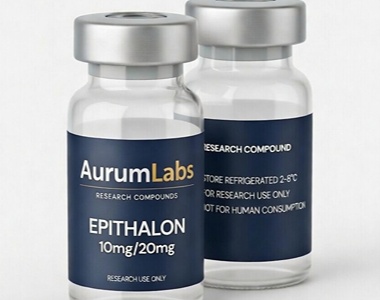
What is Epithalon?
Epithalon, also spelled Epitalon, is a tetrapeptide with the sequence Ala-Glu-Asp-Gly. It was designed to mimic the amino-acid composition of Epithalamin, an extract of the bovine pineal gland. A 2025 overview in the International Journal of Molecular Sciences traces this history and surveys 25 years of in-vitro, in-vivo and in-silico work.
Epithalon research: the main areas studied
Epithalon research clusters around three themes: telomeres, ageing and tumour models, and cell differentiation. Below, we take each in turn. The reference list at the end links to every paper mentioned.
Telomeres and telomerase
The most-cited claim concerns telomeres, the protective caps on chromosomes. A 2025 study in Biogerontology reported that Epithalon increased telomere length in human cell lines, attributing the effect to telomerase upregulation or ALT activity. That is a cell-culture finding, however, and its meaning for whole organisms is unknown.
Ageing and tumour models in rodents
A cluster of papers from the early 2000s examined rodent carcinogenesis. For instance, 2002 studies reported reduced development of mammary tumours in HER-2/neu transgenic mice and reduced colon carcinogenesis in rats. Additionally, a 2006 paper described effects on spontaneous carcinogenesis in female mice. These studies come largely from one research school, which matters for interpretation.
Cell differentiation and reproduction
Newer work broadens the picture. A 2020 paper in Molecules reported stimulation of gene expression and protein synthesis during neurogenesis in cell models. Likewise, a 2022 study in Aging reported protection of mouse oocytes from post-ovulatory ageing in vitro.
Limits of the current evidence
The weaknesses of Epithalon research are well known. Most of the literature originates from a single Russian research school, independent replication is scarce, and there are no published placebo-controlled human trials that meet modern regulatory standards. Consequently, anti-ageing claims in humans rest on extrapolation, not evidence. Careful researchers treat Epithalon as a laboratory tool for telomere and pineal research, nothing more.
Research use only
AurumLabs supplies Epithalon strictly for laboratory research. It is not for human or animal use, and it is not a medicine or supplement. If your work calls for it, our Epithalon vials ship with a batch-specific Certificate of Analysis. You can also browse the wider Longevity and Bioregulators range, or explore more summaries in our research library.
References
- Overview of Epitalon: highly bioactive pineal tetrapeptide with promising properties. Int J Mol Sci, 2025. PMID: 40141333
- Epitalon increases telomere length in human cell lines through telomerase upregulation or ALT activity. Biogerontology, 2025. PMID: 40908429
- Anisimov VN et al. Inhibitory effect of the peptide Epitalon on the development of spontaneous mammary tumors in HER-2/neu transgenic mice. Int J Cancer, 2002. PMID: 12209581
- Inhibitory effect of peptide Epitalon on colon carcinogenesis induced by 1,2-dimethylhydrazine in rats. Cancer Lett, 2002. PMID: 12049808
- Effect of the synthetic pineal peptide Epitalon on spontaneous carcinogenesis in female C3H/He mice. In Vivo, 2006. PMID: 16634527
- Khavinson V et al. AEDG peptide (Epitalon) stimulates gene expression and protein synthesis during neurogenesis. Molecules, 2020. PMID: 32019204
- Epitalon protects against post-ovulatory aging-related damage of mouse oocytes in vitro. Aging (Albany NY), 2022. PMID: 35413689
