BPC-157 research has grown steadily over the past three decades. However, most of it still comes from animal and cell studies rather than human trials. This page summarises the main areas of published work, with links to the source papers on PubMed. In short, it is a plain-language map of what the literature does and does not show. We supply BPC-157 for laboratory research only, so nothing here is medical advice or a claim about effects in humans.
Comparing repair peptides? See our side-by-side BPC-157 vs TB-500 comparison, covering origin, sequence, research models and the strength of the evidence.
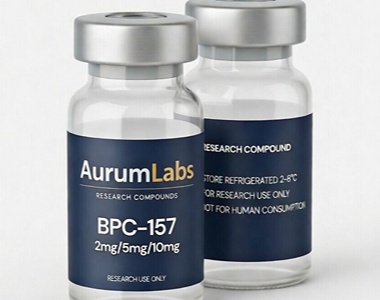
What is BPC-157?
BPC-157 is a synthetic pentadecapeptide. In other words, it is a chain of 15 amino acids. Its sequence is a partial copy of a protective protein found in human gastric juice. Researchers first described it in studies on the stomach lining. Since then, laboratories have tested it in a wide range of preclinical injury models. Because it is stable in gastric juice, it has also attracted interest as an orally active research compound.
BPC-157 research: the main areas studied
Most BPC-157 research falls into four broad areas: tendon and muscle injury, wound healing, the gastrointestinal tract, and the nervous system. Below, we take each area in turn and point to representative papers. Of course, this is a summary rather than a complete bibliography. For the full picture, the reference list at the end links to reviews that survey hundreds of studies.
Tendon, ligament and muscle models
Musculoskeletal work is the largest strand of the literature. For example, a 2011 study in the Journal of Applied Physiology examined transected rat Achilles tendon. The authors reported that BPC-157 accelerated the outgrowth of tendon fibroblasts from tendon explants. Similarly, a 2019 review in Cell Tissue Research surveyed the preclinical evidence on musculoskeletal soft-tissue healing. More recently, a 2025 systematic review in HSS Journal assessed the field from an orthopaedic sports medicine perspective. Notably, its authors stress that the compound lacks FDA approval and is banned in professional sport.
Wound healing models
A second strand covers skin and deep-tissue wounds. In particular, a 2021 review in Frontiers in Pharmacology summarised work on incisional and excisional wounds, burns and diabetic ulcers in animal models. The authors also noted that reported toxicity in these studies was low. Even so, these remain preclinical findings, and they do not establish safety or effect in people.
Gastrointestinal studies
BPC-157 began as a gastric peptide, so gut research runs deep. A 2011 paper in Current Pharmaceutical Design described it as an anti-ulcer agent studied across the oesophagus, stomach, intestine, liver and pancreas in animal models. Furthermore, the same paper notes early clinical trial work in inflammatory bowel disease. That trial history is often cited, yet published human outcome data remain very limited.
Nervous system models
Finally, a smaller body of work looks at the brain and nerves. A 2022 review in Neural Regeneration Research covered rat studies on stroke-type injury, memory and locomotion. Again, these findings come from animal models, and the authors present them as directions for further research.
Limits of the current evidence
The gaps matter as much as the findings. First, almost all BPC-157 research is preclinical, so effects in animals may not translate to humans. Second, a 2025 scoping review in Current Reviews in Musculoskeletal Medicine highlights the thin clinical data and the regulatory controversy around the compound. Third, a 2026 paper in Pharmaceutics discusses unresolved formulation and delivery questions. Therefore, strong claims about human outcomes are not supported by the literature. Careful researchers treat BPC-157 as an investigational compound, nothing more.
Research use only
AurumLabs supplies BPC-157 strictly for laboratory research. It is not for human or animal use, and it is not a medicine or supplement. If your work calls for it, our BPC-157 vials ship with a batch-specific Certificate of Analysis. You can also browse the wider Recovery and Repair range, or explore more summaries in our research library.
References
- Chang CH et al. The promoting effect of pentadecapeptide BPC 157 on tendon healing. J Appl Physiol, 2011. PMID: 21030672
- Gwyer D et al. Gastric pentadecapeptide BPC 157 and its role in accelerating musculoskeletal soft tissue healing. Cell Tissue Res, 2019. PMID: 30915550
- Emerging use of BPC-157 in orthopaedic sports medicine: a systematic review. HSS J, 2025. PMID: 40756949
- Seiwerth S et al. Stable gastric pentadecapeptide BPC 157 and wound healing. Front Pharmacol, 2021. PMID: 34267654
- Sikiric P et al. Stable gastric pentadecapeptide BPC 157: novel therapy in gastrointestinal tract. Curr Pharm Des, 2011. PMID: 21548867
- Pentadecapeptide BPC 157 and the central nervous system. Neural Regen Res, 2022. PMID: 34380875
- Regeneration or risk? A narrative review of BPC-157 for musculoskeletal healing. Curr Rev Musculoskelet Med, 2025. PMID: 40789979
- BPC-157 as an investigational peptide therapeutic: biopharmaceutical challenges and formulation strategies. Pharmaceutics, 2026. PMID: 42198317
